
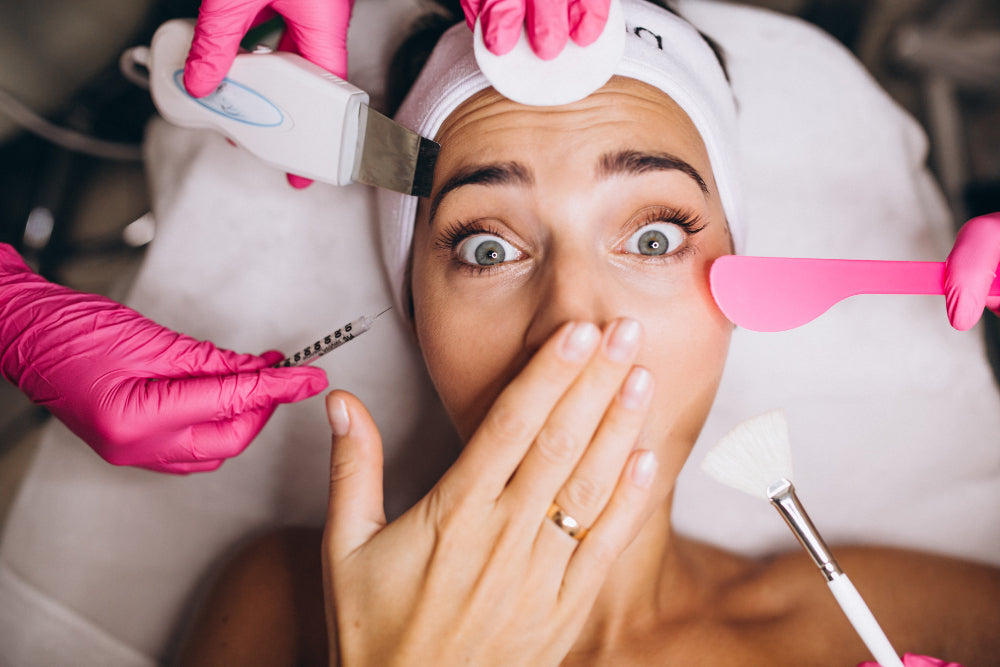
Permanent makeup (PMU) – microblading of eyebrows, eyeliner, lip blush – relies on pigments implanted in the skin . Laser hair removal, on the other hand, works by targeting pigments (those in the hair). Therefore, when an area of the face contains PMU, there is a point of caution: the laser light can interact with the PMU pigment , with a risk of skin reaction, discomfort, and sometimes even a change in the PMU's color.
This guide explains what to do before , during and after a session, and how to organize your care plan if you have (or plan to have) a PMU.
Why is PMU changing the rules of the game for laser hair removal?
Even though laser hair removal targets the melanin in the hair, the presence of PMU pigment in the beam's path can cause problems. Clinical documents on micropigmentation contain a clear warning: laser hair removal in a micropigmented area should be avoided because it can lead to a significant change in color (even darkening) .
Practical consequence: on the face, we no longer think in terms of “area to be waxed”, but rather “area to be waxed without ever crossing the PMU zone”.
The main risks to be aware of (without dramatizing)
-
PMU color change
The pigment can darken, change color, or alter unpredictably, especially if energy directly affects the pigmented area. -
Localized skin reaction
Excessive heat, redness, irritation, or even injury if you "pass over" it (hence the importance of a safety margin). -
Less even hair removal result
If we bypass the PMU area (which we should do), there may remain a small “island” of hair in or on the path, which we will manage differently.
Before the session: the checklist to follow

1) Always declare your PMU (even if it's old)
Mention it when booking and at the time of the review:
-
exact area (eyebrows, lip contour, eyeliner)
-
Date of the last appointment (creation or alteration)
-
color and style (very fine microblading vs. denser shading)
-
any past reactions (redness, slow healing, etc.)
2) If your PMU is recent: wait for complete healing
After microblading/PMU, the skin must be completely healed before considering laser treatment on the face. If you have any doubts, it is best to consult your practitioner (and, if necessary, seek medical advice).
3) Understand the technology used
A reputable center should be able to explain the type of laser used, its rationale, and how it protects at-risk areas. On SSSKIN, you can already read the basics of diode laser hair removal technology to understand the principles (targeting, parameters, importance of assessment).
During the session: what a prudent protocol should include
1) Zero shots in the PMU zone
The simplest and safest rule: never pass the laser over the PMU track .
2) Define a safety margin around the PMU
The practitioner must delineate/visualize a buffer zone around the PMU and treat only the "non-risk" area. The exact width depends on the area, pigment density, and technique.
3) Local testing if necessary
If you have very dense PMU (percutaneous mucosal hair), close to the area to be epilated, a test on a mini-area (outside PMU) may be offered to check tolerance.
After the session: what to watch for and what to avoid
-
Follow the aftercare instructions (soothing, sun protection, no irritation).
-
Watch for any unusual reaction near the PMU area: increased pain, abnormal scabs, or a very hot area. In this case, contact your practitioner immediately (and consult a doctor if the reaction is severe).
Concrete examples (face): what to do depending on the PMU zone
| PMU Zone | Example of laser hair removal requested | Cautious approach |
|---|---|---|
| Eyebrows (microblading/shading) | Cheeks/face + fine hair near the eyebrow | Treat the face, but strictly avoid the eyebrow area + safety margin |
| Eyeliner | Face / cheekbones | No direct impact if the treated area is far away; caution is advised if treatment is close to the eyes (protective measures are mandatory). |
| Lips (lip blush) | Upper lip / mouth contour | Very careful: often treatment is applied around the area, never directly onto the pigment; a local alternative is available if hairs are in the path. |
And if I want to do both: laser hair removal + PMU, in what order?

If you are planning a PMU (eyebrows, lips, eyeliner) and also laser hair removal on the face, the simplest order is often:
-
Perform laser hair removal on the affected area (when there is no pigment)
-
Then perform the PMU once the skin is stable and the hair removal plan is clear.
This logic is consistent with the warnings used in clinical settings for micropigmentation: laser hair removal in the pigmented area can change the color of the PMU, so it is better to anticipate when possible.
What to do with the hairs that are located "in" the PMU area?
If hairs remain within the treatment area (for example, in the eyebrow), the practitioner can suggest non-laser alternatives that target the pigment , depending on your skin and your goals: gentle maintenance, mechanical hair removal, or another option discussed on a case-by-case basis. The key point: do not try to "force" the laser on the pigmented area .
If you wish to start a supervised protocol, you can find SSSKIN's laser hair removal offer and ask your PMU questions during the pre-session assessment.
FAQ - Laser hair removal + PMU / microblading
Can you have laser hair removal if you have microblading?
Yes, but not “as usual”: you must strictly avoid the microbladed area and work around it, with a safety margin.
Can the PMU (French betting system) change color with a laser?
Yes, that can happen if the energy hits the pigmented area. That's why we don't treat it directly.
I have a lip blush: can I have my upper lip treated with laser?
This is a high-risk area if the pigment is close. The decision depends on your specific case (density, location, healing). A cautious approach is to treat around the pigmented area and avoid it.
I want to do some PMU betting soon: should I get laser hair removal done beforehand?
Often, yes: it simplifies things and reduces the risk of interaction with the pigment. Discuss the schedule with your practitioners.
What should I tell the practitioner before the session?
The PMU area specifies the date, retouching, color, and any past reactions. If these details are missing from the report, it's a red flag.


Share:
5 comments
I have been suffering from a deadly disease (Hsv) for the past 2 years now, I had spent a lot of money going from one places to another, from churches to churches, hospitals have been my home every day residence. Constant checks up have been my hobby not until this faithful day, I was searching through the internet, I saw a testimony on how Dr Oyagu helped someone in curing his (Hsv) herpes disease, quickly I copied his email which is oyaguherbalhome@gmail.com just to give him a test I spoke to him, he asked me to do some certain things which I did, he told me that he is going to provide the herbal cure to me, which he did, then he asked me to go for medical checkup after some days after using the herbal cure, behold I was free from the deadly disease, he only asked me to post the testimony through the whole world, faithfully am doing it now, please brothers and sisters, he is great, I owe him in return. if you are having a similar problem just email him on oyaguherbalhome@gmail.com visit his website https://oyaguspellcaster.wixsite.com/oyaguherbalhome Or WhatsApp him via +2348101755322
I have been suffering from a deadly disease (Hsv) for the past 2 years now, I had spent a lot of money going from one places to another, from churches to churches, hospitals have been my home every day residence. Constant checks up have been my hobby not until this faithful day, I was searching through the internet, I saw a testimony on how Dr Oyagu helped someone in curing his (Hsv) herpes disease, quickly I copied his email which is oyaguherbalhome@gmail.com just to give him a test I spoke to him, he asked me to do some certain things which I did, he told me that he is going to provide the herbal cure to me, which he did, then he asked me to go for medical checkup after some days after using the herbal cure, behold I was free from the deadly disease, he only asked me to post the testimony through the whole world, faithfully am doing it now, please brothers and sisters, he is great, I owe him in return. if you are having a similar problem just email him on oyaguherbalhome@gmail.com visit his website https://oyaguspellcaster.wixsite.com/oyaguherbalhome Or WhatsApp him via +2348101755322
I was diagnosed with HSV type 2 and have been dealing with it for the past two years. Recently, I came across online reviews about natural cures, where people shared their success stories of recovery through herbal treatments. After learning more, I decided to order the herbal treatment they mentioned. After taking it for just two weeks, I was completely cured! I highly recommend anyone who has been diagnosed with HSV type 2 or other similar viruses consider this treatment. You can contact Dr Lucky for more information. WhatsApp Him +2347071651140 Doctor Lucky Herbal Cure and Email drluckyherbalcure@gmail.com Also Text and Follow Him https://www.facebook.com/remedyforherpes
I have had Human Papillomavirus (HPV) for 3 months now. I have searched for cures everywhere. I have spent more money on the disease to make sure that it got cured. I was searching online on Facebook, I got a review on how Dr Lucky cured People with herbs. So I ask him for help and the way he talks to me I believe in the medicine because other people are getting cured completely and I order the medication. I got it and I applied it to this disease. Within 14 days I was cured from the HPV thanks to herbal medication Dr Lucky sent to me. If you need help he will be able to help you get rid of the Diseases, Visit his http://facebook.com/remedyforherpes Dr.Lucky ONCE AGAIN THANK YOU SIR Contact Him WhatsApp Number; +2347071651140 Or Email him at; drluckyherbalcure@gmail.com
I was diagnosed with HSV type 2 and have been dealing with it for the past two years. Recently, I came across online reviews about natural cures, where people shared their success stories of recovery through herbal treatments. After learning more, I decided to order the herbal treatment they mentioned. After taking it for just two weeks, I was completely cured! I highly recommend anyone who has been diagnosed with HSV type 2 or other similar viruses consider this treatment. You can contact Dr Lucky for more information. WhatsApp Him +2347071651140 Doctor Lucky Herbal Cure and Email drluckyherbalcure@gmail.com