
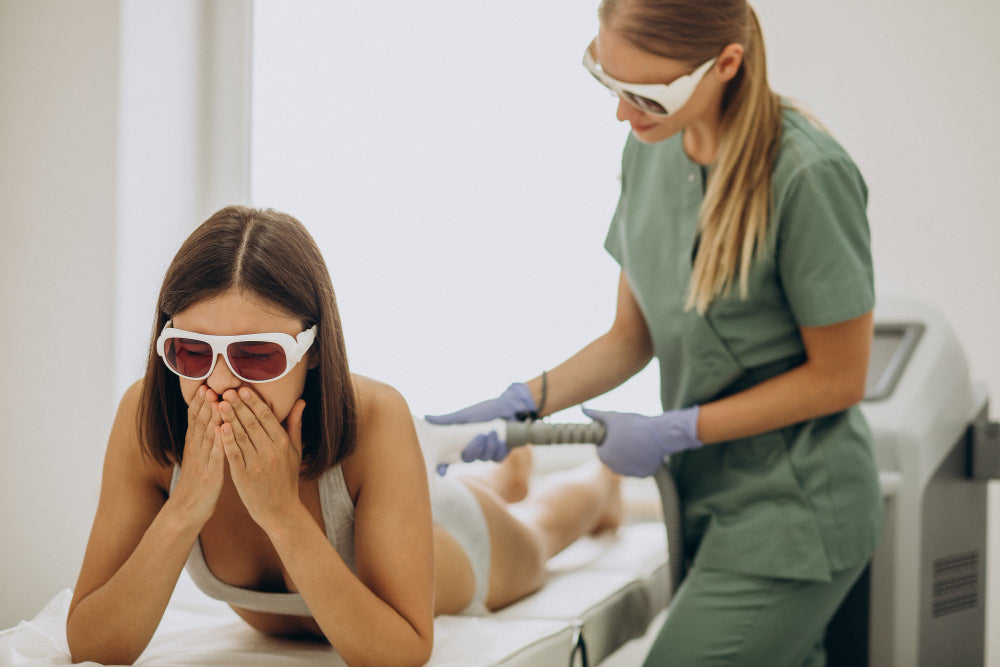
The term “painless laser hair removal” is often used in marketing. In reality, the best that laser hair removal can offer is a very well-tolerated session, thanks to cooling and settings adapted to your skin and hair. But “zero sensation” for everyone, on all areas, is not a serious promise.
In this guide, you will understand:
-
How cooling reduces discomfort
-
why some areas remain more sensitive,
-
and how to have realistic expectations (and better results) with a cautious approach like in-clinic laser hair removal .
1) What does “painless” mean in practice?
For most people, the feeling is similar to:
-
a tingling sensation or a small elastic snapping sound ,
-
a brief heat ,
-
sometimes a more pronounced discomfort in the hormonal areas.
The ideal outcome is: tolerable , quick, with skin that calms down rapidly. If you're promised "no sensation, everywhere, all the time," remain skeptical.
2) Cooling: the real “comfort” lever (but not a magic one)
Cooling is used to protect the skin and make the session more comfortable. Clinics often use a combination of these methods:
| Method | How does this help? | What it really changes |
|---|---|---|
| Integrated handpiece cooling | Cools the skin surface during firing | Less heat “on the surface”, better tolerance |
| Directed cold air | Reduces discomfort during the session | Useful in sensitive areas and large areas |
| Freezing/cold contact (according to protocols) | Improves comfort and glide | May help in certain areas and on certain devices |
A good cooling can transform a “difficult” session into a perfectly OK one, but it does not eliminate the sensation 100%, especially if the hair is thick.
To understand the principle (hair targeting, parameters, diode logic), you can read the diode laser hair removal technology page.
3) The limits: why some areas hurt more

Even with a good machine and cooling system, there are natural limitations:
Areas that are often more sensitive
-
upper lip / chin
-
bikini
-
armpits
-
areas with thicker, denser hair
Factors that increase sensation
-
very thick and very dark hair (more of a “target”)
-
irritated skin (scrub, friction, heat, aggressive shaving)
-
Sessions too close together or already sensitive skin
-
hormonal period in some people
-
stress and fatigue (lower tolerance)
Good news: as the hair decreases over the course of the sessions, many people find it becomes easier and easier .
4) The “real promises” of a well-made laser
An honest speech looks like this:
-
“We are aiming for good tolerance , not a session 'without any sensation'.”
-
“We adjust the settings according to your skin, hair type and the area.”
-
“We prioritize safety and consistency rather than going too fast.”
-
“We give you simple instructions before/after.”
If you are looking for a clear (and often more economical) plan, you can also check out our current offers .
5) How to make the session more comfortable (without dangerous tricks)
Before the session
-
Come with clean skin, free of irritating products on the area.
-
Avoid sun, self-tanner and irritations (the skin tolerates them less well).
-
Shave according to your center's instructions (a proper shave helps a lot).
During the session
-
Request a gradual approach if you are sensitive (adjusted settings, breaks, enhanced cooling).
-
Report immediately if the heat becomes “too much” (we adjust).
After the session
-
Simple hydration + avoid intense heat if the area is still sensitive.
-
If you tend to react (redness), some appreciate a gentler option like light therapy , only if your practitioner confirms that it is suitable for your skin and timing.
6) Red flags: when “painless” hides a problem

Be wary if:
-
They refuse to assess your skin/hair and your medical history.
-
They promise "guaranteed painless" without any qualification.
-
We are treating a sensitive area without discussing adaptation.
-
The risks (redness, irritation, etc.) are completely minimized.
FAQ
Can laser hair removal really be painless?
For some people, in certain areas, yes, it's "virtually painless". But the most realistic view is: well tolerated thanks to cooling and appropriate settings.
Why is the first session often more noticeable?
Because there are often more hairs, thicker hairs, therefore more to target. When the density decreases, the sensation often diminishes.
Is a "less powerful" laser better if I want zero pain?
Not necessarily. Too low a dose can yield fewer results and lengthen the protocol. The goal is the right balance: effectiveness + tolerability.
When should I seek medical advice?
If you have very reactive skin, a history of skin problems, are undergoing medical treatments, or have experienced unusual reactions after a session.


Share:
4 comments
I have been suffering from a deadly disease (Hsv) for the past 2 years now, I had spent a lot of money going from one places to another, from churches to churches, hospitals have been my home every day residence. Constant checks up have been my hobby not until this faithful day, I was searching through the internet, I saw a testimony on how Dr Oyagu helped someone in curing his (Hsv) herpes disease, quickly I copied his email which is oyaguherbalhome@gmail.com just to give him a test I spoke to him, he asked me to do some certain things which I did, he told me that he is going to provide the herbal cure to me, which he did, then he asked me to go for medical checkup after some days after using the herbal cure, behold I was free from the deadly disease, he only asked me to post the testimony through the whole world, faithfully am doing it now, please brothers and sisters, he is great, I owe him in return. if you are having a similar problem just email him on oyaguherbalhome@gmail.com visit his website https://oyaguspellcaster.wixsite.com/oyaguherbalhome Or WhatsApp him via +2348101755322
I was diagnosed with HSV type 2 and have been dealing with it for the past two years. Recently, I came across online reviews about natural cures, where people shared their success stories of recovery through herbal treatments. After learning more, I decided to order the herbal treatment they mentioned. After taking it for just two weeks, I was completely cured! I highly recommend anyone who has been diagnosed with HSV type 2 or other similar viruses consider this treatment. You can contact Dr Lucky for more information. WhatsApp Him +2347071651140 Doctor Lucky Herbal Cure and Email drluckyherbalcure@gmail.com Also Text and Follow Him https://www.facebook.com/remedyforherpes
I was diagnosed with HSV type 2 and have been dealing with it for the past two years. Recently, I came across online reviews about natural cures, where people shared their success stories of recovery through herbal treatments. After learning more, I decided to order the herbal treatment they mentioned. After taking it for just two weeks, I was completely cured! I highly recommend anyone who has been diagnosed with HSV type 2 or other similar viruses consider this treatment. You can contact Dr Lucky for more information. WhatsApp Him +2347071651140 Doctor Lucky Herbal Cure and Email drluckyherbalcure@gmail.com
I have had Human Papillomavirus (HPV) for 3 months now. I have searched for cures everywhere. I have spent more money on the disease to make sure that it got cured. I was searching online on Facebook, I got a review on how Dr Lucky cured People with herbs. So I ask him for help and the way he talks to me I believe in the medicine because other people are getting cured completely and I order the medication. I got it and I applied it to this disease. Within 14 days I was cured from the HPV thanks to herbal medication Dr Lucky sent to me. If you need help he will be able to help you get rid of the Diseases, Visit his http://facebook.com/remedyforherpes Dr.Lucky ONCE AGAIN THANK YOU SIR Contact Him WhatsApp Number; +2347071651140 Or Email him at; drluckyherbalcure@gmail.com